
In today’s fast-paced digital economy, businesses increasingly depend on multiple software systems to manage their day-to-day operations. Customer relationships are handled through CRM tools, finances are managed using accounting software, online sales run on eCommerce platforms, and deliveries are coordinated through logistics systems. While each of these tools serves a specific purpose, operating them independently often creates data silos, duplicated efforts, and a lack of real-time visibility across the organization. This fragmented approach can slow down decision-making, increase operational costs, and limit overall efficiency.
This is where Odoo Integration plays a critical role. Odoo integration enables businesses to connect all their essential systems into a single, unified ERP platform. Instead of managing separate applications, organizations can centralize their data and workflows within Odoo. Information flows seamlessly between systems, ensuring that updates in one area such as sales orders, inventory levels, or payments, are automatically reflected across the entire business. This integration reduces manual data entry, minimizes errors, and creates a single source of truth for all departments.
By integrating various tools with Odoo, businesses can streamline operations, improve collaboration between teams, and respond more quickly to market demands. Sales, finance, inventory, and logistics teams gain access to accurate, real-time data, allowing them to work more efficiently and make informed decisions. Odoo integration also supports scalability, making it easier for organizations to adopt new tools or expand operations without disrupting existing processes.
This blog explores what Odoo integration is, why it is essential for modern businesses, how it works in practice, and the tangible benefits it delivers. From improving operational efficiency to enabling smarter decision-making, Odoo integration helps businesses build a truly connected enterprise that is agile, scalable, and ready for future growth.
Technical Overview of Odoo System Integrations
Odoo Integration refers to the process of connecting the Odoo ERP platform with third-party applications, external platforms, or internal business systems so they can communicate and exchange data seamlessly. Instead of managing multiple disconnected tools, businesses benefit from a centralized environment where all operations are aligned and data remains consistent across departments. This unified approach eliminates information silos and creates a single source of truth for the organization.
Using secure APIs, ready connectors, and custom-built integrations, Odoo can synchronize data across a wide range of systems, including sales and CRM platforms, payment gateways, logistics and shipping providers, accounting software, and communication tools. As a result, critical business information such as orders, inventory levels, invoices, and customer data is updated automatically without manual intervention.
In simple terms, Odoo integration brings together multiple independent systems into one smart, connected ERP ecosystem. It enables smoother workflows, improves operational efficiency, enhances data accuracy, and allows businesses to operate with greater speed, visibility, and control.
Why Businesses Need Odoo Integration Today
Modern businesses often rely on multiple software systems to manage different functions, but when these systems operate in isolation, they create significant operational challenges. Fragmented tools lead to inefficiencies, increased workloads, and limited control over business processes. Some of the most common challenges include:
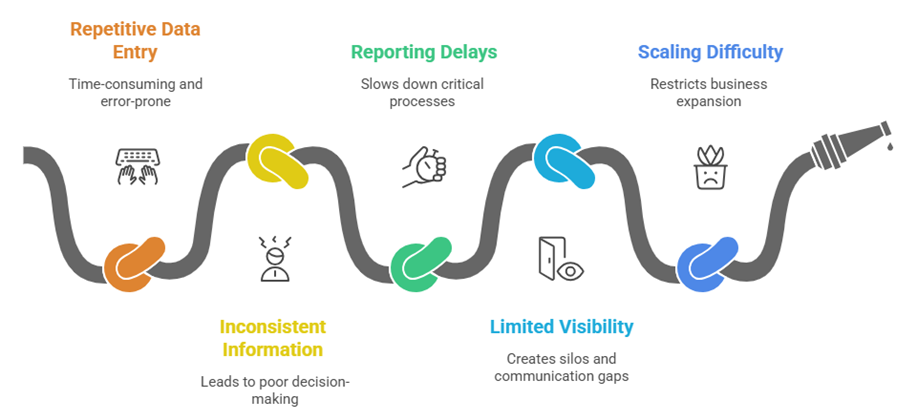
Odoo integration effectively addresses these challenges by eliminating data silos and establishing a single source of truth across the organization. When business systems are integrated with Odoo, data flows automatically between departments such as sales, finance, inventory, and operations. Teams no longer need to switch between multiple platforms or spend time manually reconciling information. Instead, workflows become seamless, efficient, and transparent.
As businesses grow and adopt more digital tools, managing disconnected systems becomes increasingly complex. Odoo integration ensures that new applications can be added without disrupting existing processes. In today’s competitive environment, integration is no longer just an operational advantage, it has become a necessity for businesses seeking efficiency, scalability, and long-term success.
How Odoo Integration Works
Odoo integration works by establishing secure connections between Odoo and external systems. These connections allow data to move automatically based on predefined rules and workflows.
For example:
- When a customer places an order on an online store, the data flows into Odoo automatically.
- Inventory levels update in real time without manual intervention.
- Invoices and payments synchronize with the accounting module.
- Shipment details update once orders are dispatched.
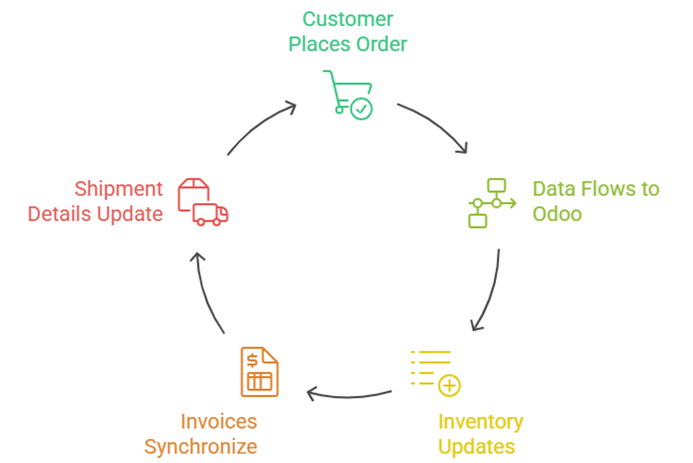
Depending on business requirements, integrations can be:
- One-way, where data flows in a single direction
- Two-way, where systems continuously exchange data
This flexibility allows businesses to design integrations that match their exact operational needs.
Standard Odoo Integrations: Predefined Connector Frameworks
Sales and Customer Management
Integrating Odoo with CRM and sales platforms ensures customer data, leads, quotations, and orders remain consistent across systems. Sales teams gain a unified view of customer interactions, enabling better engagement and faster conversions.
Finance and Accounting
Accounting integrations help automate invoice creation, payment reconciliation, tax calculations, and financial reporting. This reduces errors, ensures compliance, and provides real-time financial visibility.
Inventory and Supply Chain
With integrated inventory systems, stock levels update automatically based on sales, purchases, and production. This helps avoid overstocking, stockouts, and delays in fulfillment.
eCommerce and Online Sales
Odoo integration connects online stores directly with backend operations. Orders, customers, pricing, and inventory sync in real time, ensuring a smooth omnichannel experience.
Logistics and Shipping
Shipping and logistics integrations automate order fulfilment, tracking updates, and delivery confirmations. This improves customer satisfaction and operational transparency.
Communication and Automation
Integrating messaging, email, or notification systems ensures timely alerts, confirmations, and follow-ups, enhancing internal coordination and customer communication.
Custom Odoo Integrations: Tailored API-Driven Solutions
Centralized Operations
With Odoo integration, all business data is stored and managed within a single, unified system. This eliminates data duplication, reduces confusion caused by multiple data sources, and ensures that every department works with the same accurate information. A centralized platform improves collaboration and creates better alignment across teams.
Improved Efficiency
Automated workflows significantly reduce manual effort by eliminating repetitive tasks such as data entry and reconciliation. Processes flow seamlessly across departments, enabling teams to focus on higher-value activities. This leads to faster execution, improved productivity, and smoother day-to-day operations.
Enhanced Data Accuracy
Real-time data synchronization ensures that updates made in one system are instantly reflected across all connected platforms. This minimizes errors caused by outdated or manually entered data, improving overall data reliability and operational consistency.
Better Decision-Making
By unifying data and providing real-time reporting, Odoo integration gives management complete visibility into business performance. Accurate insights enable leaders to identify trends, address issues proactively, and make informed strategic decisions with confidence.
Scalability and Flexibility
As businesses grow, Odoo integration allows new tools, platforms, or modules to be added without disrupting existing operations. This flexibility ensures that systems evolve alongside business needs, supporting long-term growth.
Cost Optimization
Reducing manual work, operational errors, and process delays helps lower operational costs. Over time, improved efficiency and automation lead to measurable cost savings and higher return on investment.
Implementation Complexity and Configuration Flexibility
|
Integration Type |
Details |
|
Standard Integrations |
• Designed for common business requirements and widely adopted platforms • Utilize predefined connectors and standard APIs • Faster implementation with minimal development effort • Cost-effective and easier to maintain • Best suited for businesses with standardized workflows |
|
Custom Integrations |
• Developed for unique operational workflows and industry-specific needs • Support legacy systems and complex data structures • Involve custom API development and advanced data mapping • Offer greater control over logic, automation, and synchronization • Highly adaptable and scalable for complex environments |
|
Technical Considerations |
• Standard integrations provide limited configurability • Custom integrations allow fine-grained control over data flow and processes |
|
Selection Criteria |
• Business complexity and operational scale • Integration depth and performance requirements • Long-term scalability and system flexibility goals |
This structured approach helps organizations select the most suitable integration strategy based on current needs and future growth plans.
System Architecture and Data Synchronization Scope
As organizations expand, they adopt new tools to support growth. Without integration, these tools often create operational bottlenecks. Odoo integration ensures that growth remains structured and manageable.
Integrated systems:
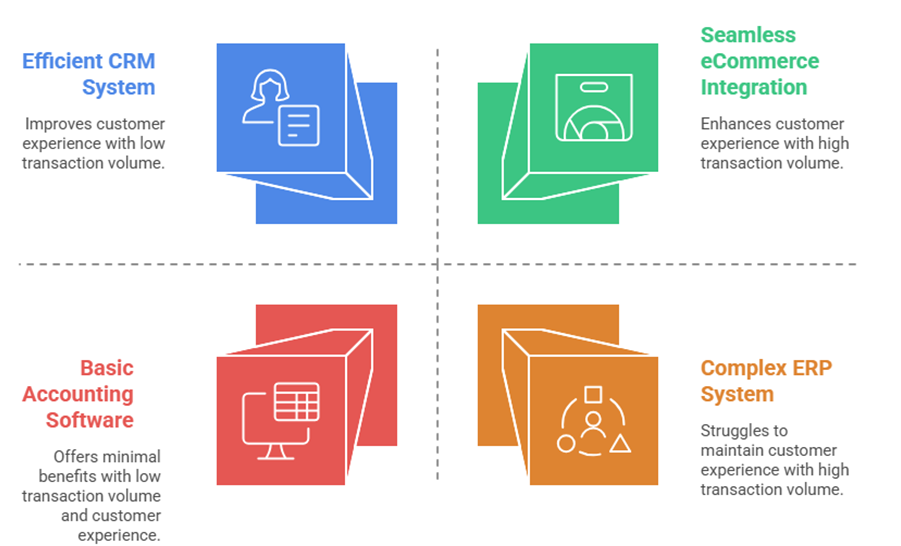
By aligning technology with business strategy, Odoo integration becomes a foundation for sustainable growth.
Performance, Scalability, and Maintenance Considerations
Data security is a critical concern when integrating systems. Odoo integrations use secure APIs, authentication protocols, and access controls to ensure safe data exchange.
With proper implementation and monitoring, businesses can maintain high levels of data integrity, confidentiality, and system reliability.
Decision Parameters for Selecting the Right Integration Model
Odoo integration is more than just connecting software, it is about creating a unified, intelligent business ecosystem. By bringing together sales, finance, inventory, operations, and communication tools into one platform, businesses gain clarity, control, and efficiency.
In an era where agility and data-driven decision-making define success, Odoo integration empowers organizations to break down silos, streamline operations, and scale with confidence.
Whether you are a growing enterprise or an established organization, investing in Odoo integration is a strategic step toward building a smarter, more connected ERP system that supports long-term success.